
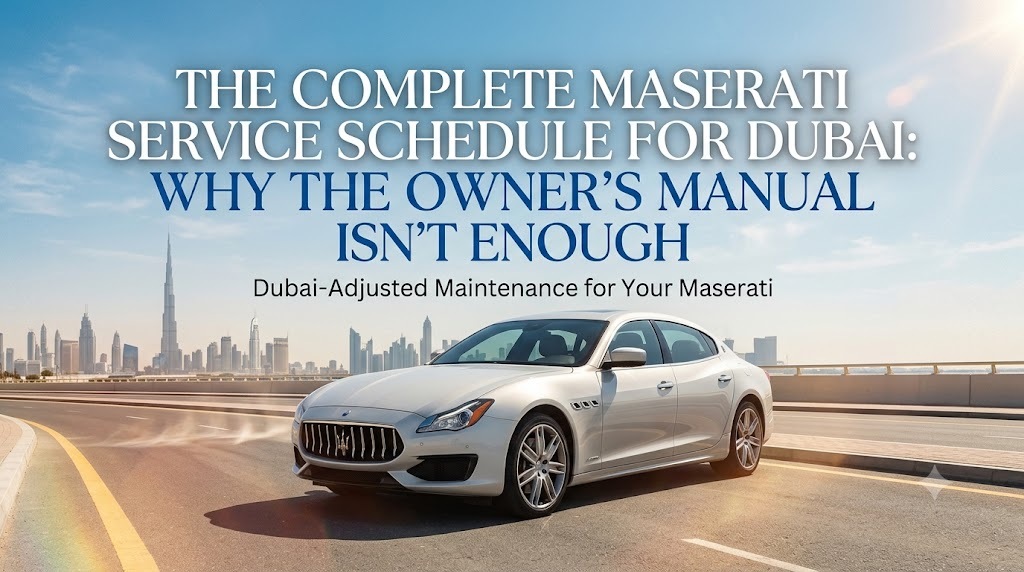
Every Maserati leaves the factory with a recommended maintenance schedule. It is a sensible document — written for a car driven on European roads, in European temperatures, with European fuel and European dust levels. Follow it to the letter in Dubai, and you will be under-maintaining your car in almost every category that matters.
This is not a criticism of Maserati. It is simple physics. Heat is the enemy of everything in a car: oil, coolant, rubber, plastic, batteries, refrigerant, and transmission fluid all age faster at Gulf temperatures. Dust accelerates wear in filters, brakes, and turbochargers. The “severe conditions” footnote buried in your owner’s manual? Dubai is what that footnote was written for — permanently.
Here is a realistic, climate-adjusted service schedule for Maseratis driven in the UAE, covering the Ghibli, Quattroporte, Levante, GranTurismo, and GranCabrio, along with an explanation of why each interval is shortened.
Engine Oil and Filter: Every 8,000–10,000 km (or 12 Months)
The factory schedule allows up to 15,000 km between oil changes on many models. In Dubai, that is too long. Sustained high temperatures oxidise oil faster, short air-conditioned trips promote fuel dilution, and the twin-turbo V6 in the Ghibli and Levante runs its turbo bearings on that same oil at enormous temperatures. Degraded oil is directly linked to timing chain wear, turbo bearing failure, and sludge — three of the most expensive engine problems a Maserati can develop.
Dubai rule: 8,000–10,000 km with a genuine filter and the exact specified oil grade. Never stretch it because “the car feels fine.” Oil failure is silent until it isn’t.
Air Filters: Inspect Every 10,000 km, Replace Every 20,000 km
In Europe, engine air filters can last 40,000 km. In Dubai, fine desert dust loads them far faster, and a restricted filter on a turbocharged engine means the turbos work harder to pull air through, while any dust that sneaks past acts as an abrasive inside the engine. Cabin filters clog even faster and matter for both AC performance and the air you breathe.
Dubai rule: engine air filters checked at every oil service and replaced roughly twice as often as the book says. Cabin filter annually, before summer.
Brake Fluid: Every 2 Years — No Exceptions
Brake fluid is hygroscopic: it absorbs moisture from the air, and Dubai’s coastal humidity accelerates this. Moisture in brake fluid lowers its boiling point, corrodes internal brake components, and on a car with the performance of a Maserati, degraded fluid is a genuine safety issue. This is one of the most commonly skipped services because the symptom — a slightly softer pedal — creeps in gradually.
Dubai rule: full fluid flush every 24 months with the correct DOT specification, regardless of mileage.
Coolant System: Pressure Test Annually, Replace Coolant Every 3–4 Years
Between the heat and the workload, the cooling system on a Dubai-driven Maserati deserves an annual health check: a pressure test to find weeping hoses or a tired expansion tank, a check of coolant condition and concentration, and a visual inspection of every plastic component. Plastic cooling parts in the Gulf become brittle years ahead of schedule, and a failure invariably happens in July traffic, not on a cool morning in your driveway.
Dubai rule: annual pressure test; proactive replacement of aging plastic parts; fresh coolant every 3–4 years.
Transmission Fluid: Every 60,000 km on Automatics
Maserati calls the ZF 8-speed’s fluid “lifetime fill.” ZF, the manufacturer of the gearbox, recommends changes at 80,000–120,000 km — and sooner in severe conditions. Dubai traffic and heat are severe conditions. Fresh fluid with a genuine pan-and-filter unit is the single most cost-effective thing you can do for the long-term health of the transmission.
Dubai rule: fluid and filter every 60,000 km. It is a fraction of the cost of any transmission repair.
Battery: Test Every Service, Expect 2 Years of Life
Dubai heat kills batteries early, and Maseratis respond to weak batteries with a fireworks display of unrelated warning lights. Load-test the battery at every service and replace it on condition, not on failure — because failure will happen at the worst possible moment, and voltage sags can even corrupt module software.
Tyres and Alignment: Rotate Every 10,000 km, Align Annually
Hot asphalt is abrasive, and UAE road surfaces plus speed bumps knock alignment out more often than owners expect. Misalignment on a heavy, powerful sedan chews through expensive tyres in months. Check pressures monthly — heat swings change them significantly — and inspect for sidewall damage from kerbs and bumps.
AC System: Full Check Every Year, Before Summer
Condenser cleaning, refrigerant pressure check, drain inspection, and evaporator disinfection every spring. In this climate the AC is not comfort equipment; it is core infrastructure, and pre-summer servicing is dramatically cheaper than mid-summer failure.
Belts, Hoses, and Rubber Components: Inspect Every Service
UV exposure and heat harden and crack every rubber component: serpentine belts, coolant hoses, suspension bushings, engine mounts, wiper blades, door seals. A ten-minute visual inspection at each service catches these before they strand you or cause secondary damage.
Why Where You Service Matters as Much as When
A climate-adjusted schedule only works if the workshop executing it knows Maseratis. These cars need the correct fluids to exact specifications, genuine or OEM-quality filters and parts, and — critically — factory-capable diagnostic equipment to read service data, reset adaptations, and catch stored fault codes at every visit. A general workshop changing oil without reading the car’s systems is doing half a service.
For a proper, climate-aware maserati service dubai programme, look for a workshop that specialises in the brand, stocks the correct fluids and filters, documents everything for your service history, and inspects the known Gulf weak points — cooling plastics, battery, condenser, bushings — as standard at every visit rather than waiting for symptoms.
The Economics of Doing This Properly
Owners sometimes look at a climate-adjusted schedule and see more frequent servicing as added cost. The arithmetic says otherwise. Compare the cost of ten years of diligent oil changes against a single turbocharger or timing chain job. Compare annual cooling system checks against one overheated cylinder head. Compare a transmission fluid service against a gearbox rebuild. In every case, a decade of prevention costs less than one major failure — and that is before counting the resale value of a Maserati with a documented, specialist service history versus one with gaps.
Dubai is a spectacular place to own a Maserati: perfect winter driving weather, great roads, and a car culture that appreciates the brand. The climate simply demands that you maintain the car on Dubai’s terms, not Modena’s. Adjust the schedule, choose your workshop well, and your Maserati will be as reliable as it is beautiful.