
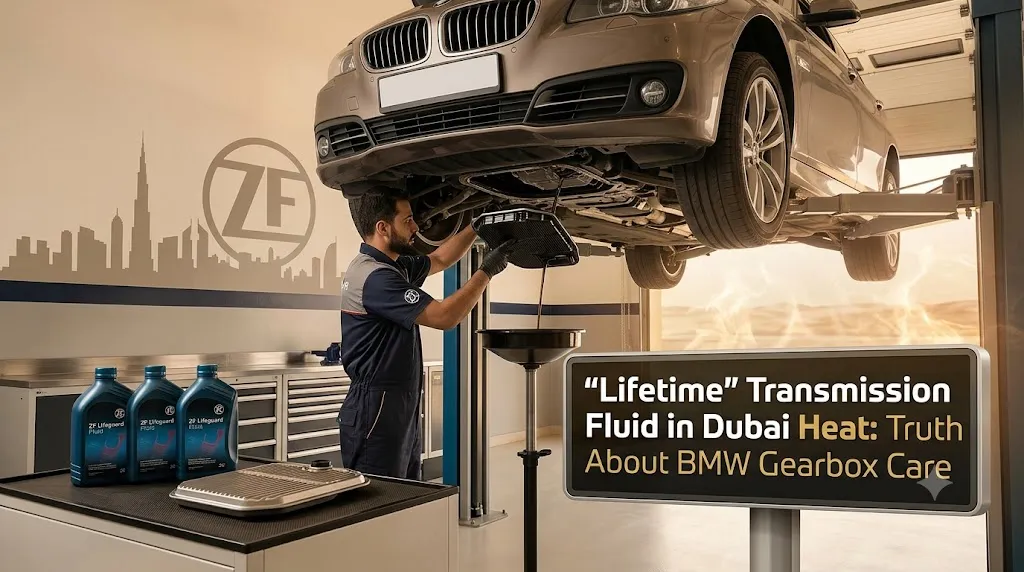
Few phrases in modern car ownership have caused more expensive misunderstandings than “lifetime fill.” BMW’s automatic transmissions — overwhelmingly the excellent ZF 8HP eight-speed in everything from the 2 Series to the 7 Series and X models — are officially described as sealed for life, with no scheduled fluid changes. What most owners never hear is the quiet second half of that story: ZF itself, the company that designs and builds the gearbox, recommends a fluid and filter change every 80,000–100,000 km, and explicitly sooner under severe conditions. Sustained high ambient temperatures, stop-and-go traffic, and towing are the textbook definitions of severe conditions. In other words: Dubai.
Why Heat Is the Whole Story
An automatic transmission is a hydraulic computer. Its fluid is not just a lubricant — it is the working medium that applies clutches, the coolant that carries heat away from friction surfaces, and the medium through which the mechatronic valve body makes every shift decision. All of the fluid’s properties — viscosity, friction coefficient, oxidation resistance — are engineered around an assumed operating temperature window, typically 80–95°C.
Every sustained period above that window accelerates fluid oxidation. Oxidised fluid loses its friction modifiers, which is why the first symptom of tired transmission fluid is almost never a catastrophic failure — it is a subtle degradation in shift quality. A slight shudder at low speed. A momentary flare between second and third. A clunk when shifting from Reverse to Drive that wasn’t there last year. In Gulf summer traffic, transmission fluid temperatures regularly reach 110–120°C, and every one of those journeys takes a small permanent bite out of the fluid’s remaining life.
The clutch material worn from the friction plates, meanwhile, circulates in the fluid as fine dark sediment. Some is captured by the filter (integrated into the plastic oil pan on the 8HP), but the rest gradually accumulates in the valve body, where solenoids meter fluid through passages finer than a millimetre. This is the mechanism behind most 8HP complaints: not broken hardware, but a mechatronic unit making imprecise shifts because it is metering dirty, degraded fluid through partially restricted passages.
The Symptoms Owners Actually Notice
In a workshop that sees BMWs every day, transmission complaints in the UAE cluster into recognisable patterns:
Shudder or vibration at 40–60 km/h under light throttle. Usually torque converter lock-up clutch judder — a classic degraded-fluid symptom, and often completely cured by a proper fluid service if caught early.
Harsh 2–1 downshift when coming to a stop. The most common single 8HP complaint. Frequently improved by fluid service and, on some models, software updates that recalibrate shift adaptation.
Delayed engagement when selecting Drive or Reverse after the car has sat in the sun. Heat-soaked fluid thins out; worn seals inside the transmission allow pressure to bleed off. A warning sign worth acting on.
“Transmission Malfunction — Drive Moderately” messages in summer traffic. Often triggered by fluid temperature exceeding thresholds, sometimes compounded by a partially clogged transmission cooler or a failing thermostat in the cooling circuit.
None of these symptoms means the gearbox is finished. The 8HP is fundamentally durable — examples with proper fluid maintenance routinely exceed 300,000 km. The transmissions that fail young are, almost without exception, the ones that ran their original fluid deep into the six-figure kilometre range in this climate.
What a Proper Transmission Service Involves
A genuine BMW transmission service is more involved than a generic fluid swap, and the details matter enormously:
The pan and filter are one part. On the ZF 8HP, the filter is moulded into the plastic sump. A proper service replaces the entire pan assembly — genuine ZF or OEM — along with the bolts, which are stretch-to-fit and not meant for reuse.
Fluid specification is non-negotiable. The 8HP requires a specific ZF LifeguardFluid formulation. Universal “multi-vehicle” ATF from a bulk drum is responsible for a remarkable share of post-service shudder complaints. The friction characteristics are simply different.
Fill level is set by temperature. There is no dipstick. The correct level is set with the fluid at a precise temperature window (typically 30–50°C, model-dependent) with the engine running, monitored by diagnostic software. Overfilled or underfilled transmissions both misbehave, and this step is where inexperienced workshops most often go wrong.
Adaptations should be reset and relearned. After service, clearing the transmission’s learned adaptation values and performing a proper drive cycle lets the mechatronics recalibrate to the fresh fluid’s friction behaviour.
A related question owners ask constantly: should high-mileage fluid be changed at all, given the internet folklore that “changing old fluid kills transmissions”? The folklore has it backwards. Fresh fluid does not damage transmissions; it occasionally reveals damage that already existed, because a gearbox that was only functioning thanks to thickened, sludgy fluid is a gearbox already on borrowed time. The correct conclusion is not “never change it” but “change it early and regularly so you never reach that point.” For a car with completely unknown history at 180,000 km, a measured approach — fluid analysis, gentle service rather than aggressive flushing — is sensible, and a good workshop will advise honestly rather than upselling.
The Supporting Cast: Coolers, Mounts, and Software
Transmission health in this climate is not only about fluid. The 8HP exchanges heat with the engine cooling circuit through a heat exchanger, so a tired engine cooling system directly raises transmission temperatures — another reason cooling maintenance pays double dividends here. Transmission and engine mounts, softened by heat and oil contamination, exaggerate shift clunks and are frequently misdiagnosed as internal gearbox problems. And BMW has released numerous transmission software updates over the years addressing shift quality complaints; a car that has never been updated may be running calibration that BMW itself superseded a decade ago.
This is why diagnosis should come before any expensive decision. A drive cycle with live data — fluid temperature, adaptation values, solenoid currents, slip measurements — distinguishes between a AED 1,500 fluid service, a AED 500 engine mount, and a genuine mechatronic problem. Guessing is expensive; measuring is cheap. If your BMW has developed a shudder, a clunk, or hesitant shifting, having it assessed at an experienced bmw garage dubai with proper ZF service equipment and BMW diagnostic software is the fastest route to the right answer rather than the most profitable one.
A Sensible Ownership Policy
For BMW owners in the UAE who intend to keep their cars, the evidence points to a simple policy. Service the transmission fluid and pan every 60,000–80,000 km — earlier than ZF’s global guidance, because this climate is the severe case the fine print warns about. Insist on genuine fluid and the correct temperature-controlled fill procedure. Keep the engine cooling system healthy, because the gearbox borrows its cooling from it. Investigate new shift-quality symptoms promptly, while they are still fluid problems rather than hardware problems.
“Lifetime fill” is true in only one sense: the fluid will indeed last the lifetime of the transmission — because degraded fluid is very often what determines that lifetime. In Dubai’s heat, the owners who ignore the marketing phrase and service the gearbox anyway are the ones whose transmissions quietly last twenty years.