
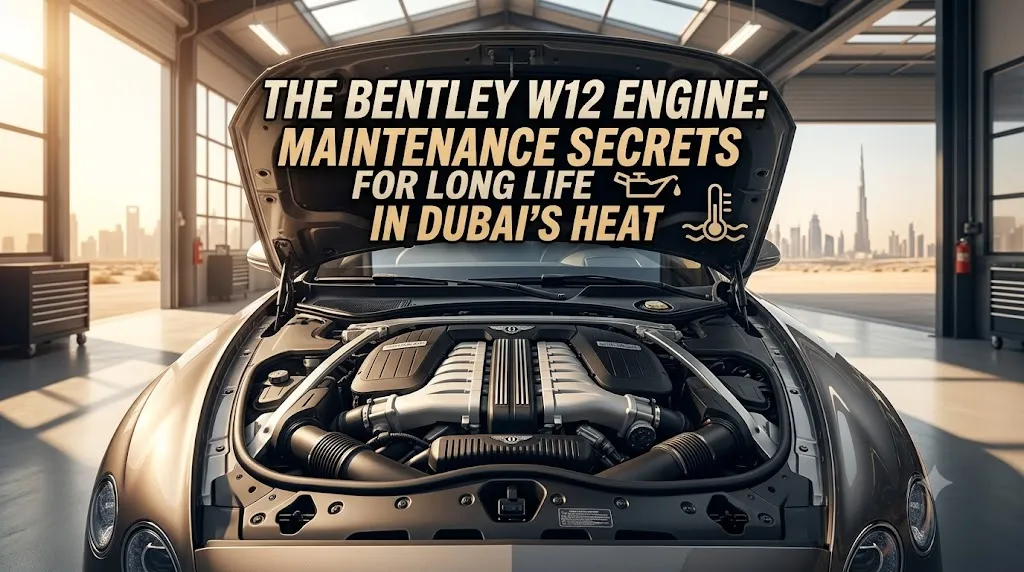
Few engines in modern motoring carry the mystique of Bentley’s 6.0-litre twin-turbo W12. Fitted to the Continental GT, Flying Spur, and Bentayga, it delivers colossal, effortless torque and a character no V8 quite matches. With production of the W12 now ended, these engines are becoming modern classics — which makes maintaining them properly more important than ever, especially for the large population of W12 Bentleys on UAE roads.
Here is what every W12 owner in Dubai should understand about this engine, its known weak points, and the maintenance schedule that keeps it healthy in one of the hottest climates on earth.
What Makes the W12 Special — and Challenging
The W12 is effectively two narrow-angle VR6 engines sharing a single crankshaft. This layout makes it remarkably short and compact for a 12-cylinder — barely longer than many V8s. That compactness is also its biggest maintenance challenge: components are tightly packed, airflow through the engine bay is restricted, and under-bonnet temperatures run extremely high.
In Dubai, where ambient temperatures exceed 45°C for months and cars endure long idling in traffic with the AC at full blast, heat management is the single most important factor in W12 longevity.
Known Weak Point #1: The Cooling System
Ask any Bentley technician what fails first on an ageing W12 and the answer is almost always the same: plastic cooling system components. The engine uses numerous plastic coolant pipes, Y-connectors, thermostat housings, and a coolant transfer pipe arrangement that all become brittle after years of heat cycling.
Typical failure points include:
- The plastic coolant pipes running between the cylinder banks
- Thermostat housing and its seals
- Water pump (both the mechanical pump and, on later cars, auxiliary electric pumps)
- Radiator end tanks and hose junctions
- The expansion tank, which can develop hairline cracks
The frustrating part is access: many of these parts sit deep in the engine’s valley or behind ancillaries, so labour makes up a large share of the bill. The smart approach — and what experienced workshops recommend — is to replace related plastic components together whenever the front of the engine is opened up. Paying for one part’s labour twice is far more expensive than doing the neighbouring parts preventively.
The rule for Dubai: never ignore a coolant smell, a low coolant warning, or residue around hose joints. An overheated W12 risks head gasket and liner damage, turning a AED 3,000 pipe job into a five-figure rebuild.
Known Weak Point #2: Carbon Buildup and Misfires
Later W12s use direct fuel injection, which means fuel never washes over the intake valves. Over tens of thousands of kilometres, oil vapours from the crankcase ventilation system bake onto the valves as hard carbon deposits. Symptoms include rough cold idle, hesitation, misfire codes on individual cylinders, and gradually dulled throttle response.
The fix is walnut blasting — media-blasting the intake ports clean with crushed walnut shell — typically recommended every 80,000–100,000 km. Alongside this, ignition coils and spark plugs are consumables: with twelve of each, a single failing coil causes a misfire that owners often mistake for something far more serious. A workshop with proper diagnostics can identify the exact cylinder in minutes.
Known Weak Point #3: Oil Leaks and the Breather System
Valve cover gaskets, cam cover seals, and the crankcase breather components harden in the heat and begin to seep. A light film of oil on a W12 is common on older cars, but active drips onto hot exhaust components are both a fire risk and a sign the breather system may be over-pressurising the crankcase. Replacing breather valves and hardened seals restores proper crankcase vacuum and often cures mysterious oil consumption at the same time.
Known Weak Point #4: Turbochargers and Charge Cooling
Two turbos hang off this engine, and they live a hard life in UAE conditions. Watch for:
- Boost leaks from perished charge pipes and couplers (whistles, reduced power, boost deviation fault codes)
- Wastegate rattle at idle on higher-mileage cars
- Charge cooler efficiency loss — the water-to-air intercooling system depends on its own low-temperature coolant circuit, and airlocks or weak auxiliary pumps cause heat soak and power loss on hot days
If your W12 feels noticeably slower in summer than winter, the charge cooling circuit deserves inspection before anyone blames the turbos themselves.
The Maintenance Schedule That Works in the UAE
Bentley’s official intervals were written for global averages. For Dubai’s climate, seasoned specialists recommend tightening them:
- Engine oil and filter: every 8,000–10,000 km with the correct specification synthetic — not the 15,000 km some schedules allow. Heat degrades oil faster, and the W12’s turbos depend on clean oil.
- Coolant: test annually, replace every 3–4 years with the correct G12/G13-class coolant. Never mix types.
- Spark plugs: every 60,000 km.
- Transmission fluid: every 60,000 km despite any “lifetime fill” claims.
- Auxiliary belt and tensioners: inspect annually; heat-cracked belts fail without much warning.
- Annual cooling system pressure test: cheap insurance that catches leaks while they are still small.
Why Specialist Knowledge Matters for the W12
The W12 is not an engine for general workshops. Its packaging means diagnosis by guesswork gets ruinously expensive, and many jobs require Bentley-specific procedures, adaptations, and software. A workshop that services these cars weekly will know, for example, which coolant pipes to replace together, how to bleed the charge cooler circuit properly, and which fault codes are red herrings caused by a tired battery.
For owners searching for trusted bentley repair dubai options beyond the main dealer, the key questions to ask any workshop are simple: How many W12s do you service each month? Do you have factory-level diagnostics? Can you show me genuine or OEM parts sources? The right answers save you a fortune over the life of the car.
The Bottom Line
The W12 rewards proactive owners. Nearly every major failure this engine suffers begins as a small, cheap problem — a weeping plastic pipe, a lazy breather valve, one tired coil. Caught early, they are routine maintenance. Ignored through a Dubai summer, they escalate quickly.
With production ended, well-maintained W12 Bentleys are likely to hold their value increasingly well. Look after the cooling system, respect the oil intervals, and this extraordinary engine will deliver its silken twelve-cylinder thrust for hundreds of thousands of kilometres — exactly as Crewe intended.