
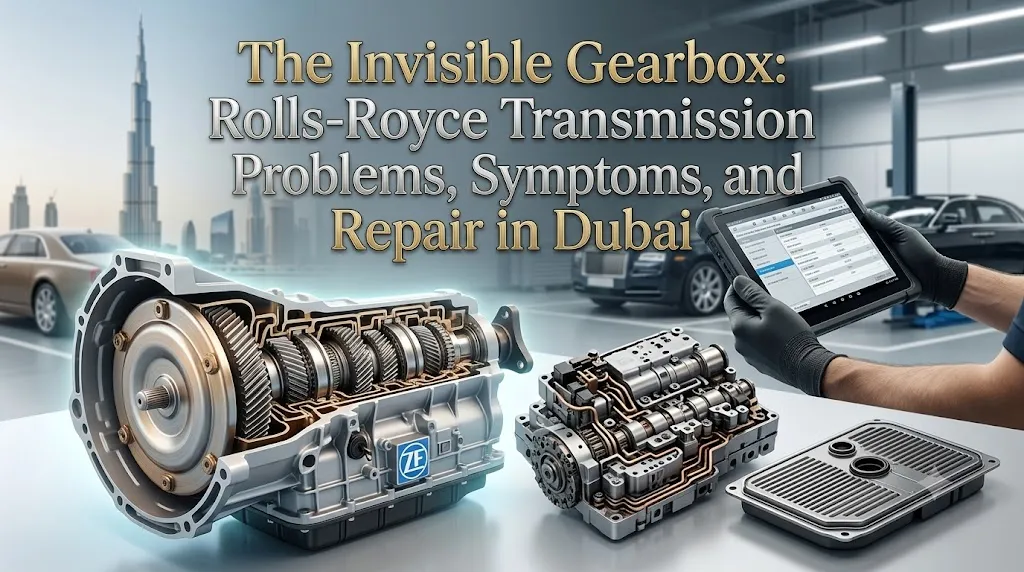
Rolls-Royce engineers set themselves a peculiar goal with the transmission: the driver should never notice it exists. The ZF eight-speed automatic fitted to modern models — enhanced on some cars with satellite-aided shifting that uses GPS data to select gears before corners arrive — comes remarkably close to that ideal. Shifts are imperceptible, kickdown is a distant memory, and the car simply surges forward on a wave of torque.
That very invisibility is the problem when something starts to go wrong. On most cars, a transmission announces its troubles loudly. On a Rolls-Royce, the early symptoms are whispers — a shift that is merely almost imperceptible, a hesitation measured in tenths of a second — and owners routinely drive past the cheap-repair window without ever knowing it was open. In Dubai’s heat and traffic, that window is shorter than anywhere else the car is sold.
What the Transmission Endures in the Gulf
Heat is the transmission’s mortal enemy. Automatic transmission fluid does three jobs at once: it transmits power through the torque converter, actuates the clutches hydraulically, and lubricates and cools everything. Fluid life is directly governed by temperature — as a rule of thumb, sustained operation significantly above design temperature can halve fluid life or worse. Dubai supplies elevated ambient temperatures, radiated heat from asphalt, and the specific torture of stop-start traffic, where the torque converter churns fluid into heat at every standstill while airflow through the transmission cooler is minimal.
“Sealed for life” meets Gulf reality. ZF transmissions are often described as filled for life, and in temperate climates with average use the claim is defensible. In the Gulf, specialists who open these gearboxes see the truth in the fluid: dark, oxidised, carrying clutch material, sometimes with a burnt odour, at mileages where European fluid would still be serviceable. The consensus among independent experts working on these cars in the region is unambiguous: fluid and filter (the filter is integrated in the oil pan) should be changed every 60,000–80,000 km in Gulf conditions, using the exact ZF-specification fluid. It is the single highest-value preventive job on the drivetrain.
Low-speed duty cycles. The mechatronic unit — the transmission’s hydraulic-electronic brain — performs thousands of precise pressure adjustments in city driving. Solenoid valves wear, internal seals harden in heat, and pressure control gradually loses precision. Dubai’s traffic profile accelerates exactly this wear pattern.
The Symptoms — In Order of Urgency
Subtle early signs (the cheap window):
- Shifts that can be felt at all, especially 1st–2nd and 2nd–3rd when warm
- A brief hesitation when accelerating from a rolling stop
- A gentle shudder at low speed under light throttle — often torque converter lock-up clutch judder, a classic degraded-fluid symptom
- Slightly delayed engagement when selecting Drive or Reverse from Park
Intermediate signs:
- A noticeable flare (engine revs rising momentarily between gears)
- Harsh downshifts when slowing to a stop
- A transmission warning message that appears and clears
Urgent signs (stop driving, arrange recovery):
- Transmission fault message with limp mode (held gear, reduced power)
- Slipping — engine speed rising without corresponding acceleration
- Burnt smell, fluid leak spots, or metallic noises from the gearbox
The economics are stark. Addressed at the “subtle” stage, the remedy is often a fluid and filter service and perhaps software adaptation — a routine job. At the “slipping” stage, clutch packs have worn against contaminated fluid, debris has circulated through the mechatronic valves, and the conversation involves overhaul or replacement at many multiples of the cost.
Faults Specialists Actually See on These Cars
1. Degraded fluid masquerading as mechanical failure. The most common finding. Judder, soft shifts, and hesitation frequently resolve completely with a proper fluid exchange, pan and filter replacement, and adaptation reset. This is also why diagnosis must precede any talk of overhaul.
2. Mechatronic sleeve and adapter leaks. The electrical connector sleeve where the loom enters the transmission is a known seep point on high-heat cars; fluid wicks along the loom. The repair is inexpensive if caught — a sleeve and seal — but chronic low fluid from an unnoticed leak is lethal to the gearbox.
3. Torque converter lock-up clutch wear. The converter locks at low speeds for efficiency, and its clutch lives a hard life in traffic. Persistent low-speed shudder after a fluid service points here.
4. Valve body/mechatronic wear. Worn solenoids and valve bores cause inconsistent shift quality that varies with temperature. Repairable by specialists with the equipment to test and rebuild the unit — far cheaper than transmission replacement.
5. Software and adaptation issues. The transmission continuously adapts to clutch wear and driving style. After repairs, battery events, or module faults, adaptations can be corrupted, producing rough behaviour with no mechanical cause. The fix is diagnostic: reset and relearn under prescribed drive cycles.
6. Cooling system faults. The transmission cooler and its thermostatic control keep fluid in its operating window. A partially blocked cooler — sand again — silently cooks the fluid. Any Gulf transmission diagnosis should include verification of cooler flow and fluid temperature behaviour.
What Correct Repair Practice Looks Like
A professional approach follows a strict order: diagnose, service, reassess, then repair.
Diagnosis means factory-level electronic interrogation — fault memory, live pressure data, clutch adaptation values, temperature history — combined with a road test by someone who knows what these cars should feel like. Adaptation values alone tell an experienced technician how much clutch life remains.
Service means a genuine fluid exchange: pan off, integrated filter replaced, new pan gasket and bolts, exact-specification fluid filled and levelled at the precise temperature the procedure demands (the level is temperature-critical and cannot be set correctly without diagnostic equipment reading fluid temperature live), followed by adaptation reset and a structured relearn drive.
Only if symptoms persist after clean fluid and fresh adaptations does mechanical repair enter the conversation — and then it should be targeted (converter, mechatronic, specific clutch pack) based on evidence, not a reflexive “replace the transmission” quote.
This discipline is where specialist workshops earn their reputation. Owners searching for capable rolls royce repair dubai should ask pointed questions: Does the workshop stock the correct ZF-specification fluid? Can they read live transmission data and adaptation values? Have they performed the temperature-controlled fill procedure on this transmission family? Will they diagnose before quoting repair? Confident, specific answers to those four questions separate genuine specialists from general garages with a lift and good intentions.
Habits That Extend Transmission Life in Dubai
- Come to a complete stop before shifting between Drive and Reverse — always.
- In long standstill traffic, slip into Neutral or use the auto-hold function during extended halts to reduce converter heat generation.
- Allow gentle driving for the first minutes after a start; fluid needs to warm and circulate.
- Never ignore the first shudder or hesitation — book a diagnosis while the fix is still a fluid service.
- Put the 60,000–80,000 km fluid service in the car’s calendar as a non-negotiable, regardless of what “sealed for life” implies.
The transmission was engineered to disappear beneath the experience. With Gulf-appropriate maintenance and specialist attention at the first whisper of change, it will stay invisible — which, in a Rolls-Royce, is precisely the point.