
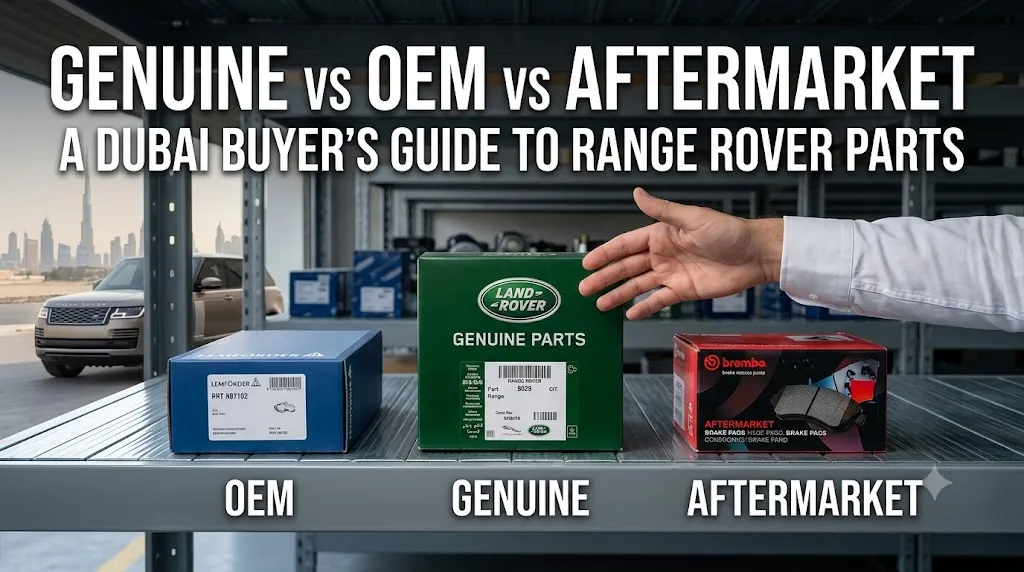
Walk into any parts market in Dubai or Sharjah and ask for a Range Rover water pump, and you will be offered at least four versions of the “same” part at wildly different prices. One is in a green Land Rover box. One is in a plain white box with the same casting marks. One carries a German brand name. One has no brand at all. Which should you buy?
For Range Rover owners in the UAE — where dealer servicing is expensive and the independent parts trade is enormous — understanding the difference between genuine, OEM, and aftermarket parts is the single most valuable piece of ownership knowledge. This guide breaks it down clearly.
The Three Tiers Explained
Genuine parts are components sold in official Land Rover packaging through the JLR supply chain. Critically, Land Rover manufactures very few parts itself. The part inside that green box was made by a supplier — Valeo, Bosch, Mahle, Dunlop, ZF, Lemförder, and dozens of others — then boxed and branded by JLR. You pay for the logo, the packaging, and the dealer-network warranty.
OEM (Original Equipment Manufacturer) parts are made by that same supplier, often on the same production line, but sold in the supplier’s own packaging. A Lemförder control arm for a Range Rover Sport may be physically identical to the genuine item, minus the Land Rover branding, at a substantially lower price. In the trade these are sometimes called OES (Original Equipment Supplier) parts.
Aftermarket parts are made by companies that were never original suppliers to JLR. Quality here ranges from excellent (Brembo brakes, febi bilstein service parts, Britpart for Land Rover applications) to genuinely dangerous unbranded copies. The aftermarket tier is where buyer knowledge matters most.
Where Each Tier Makes Sense
There is no single right answer — a smart owner mixes tiers depending on the component.
Buy genuine or OEM for:
- Engine internals and timing components. A failed timing chain tensioner on a 5.0 V8 or 3.0 supercharged V6 destroys the engine. The saving on a copy part is trivial against that risk.
- Air suspension components. Rubber compound quality is invisible until the spring fails, and inferior bellows fail fast in UAE heat.
- Electronic modules and sensors. Crank sensors, ride height sensors, and control modules from unknown makers cause intermittent faults that cost more in diagnosis time than the part saved.
- Cooling system parts. In Gulf summers, the cooling system is a safety system. Thermostats, water pumps, and radiators should be original-supplier quality.
Quality aftermarket is fine for:
- Filters and routine service items from recognised brands like Mann, Mahle, or Bosch.
- Brake pads and discs from Brembo, Textar, or ATE — often these exceed genuine specifications.
- Suspension bushes and links from Lemförder, Meyle, or febi.
- Body hardware, trims, and clips where fitment, not durability, is the only question.
Avoid entirely:
- Unbranded electrical parts, unbranded brake components, and any “genuine” part offered at a price too good to be true — Dubai’s re-export trade unfortunately includes counterfeit packaging that is very convincing.
How to Spot Counterfeit “Genuine” Parts
The UAE parts market is largely honest, but fakes circulate. Protect yourself with these checks:
- Verify the part number against your VIN. Any serious supplier can decode your chassis number and confirm the exact part number before sale. If a seller cannot or will not do this, walk away.
- Inspect packaging quality. Genuine JLR boxes have consistent print quality, correct fonts, and matching labels. Blurry logos, misspelled words, and re-taped boxes are red flags.
- Check casting and moulding marks. Original-supplier parts carry the maker’s logo (Valeo, Mahle, etc.) cast into the component. Copies often have ground-off or absent marks.
- Ask for an invoice with the part number stated. Legitimate traders document what they sell; counterfeit sellers prefer cash and vagueness.
- Compare weight and finish against the old part where possible. Copies frequently use thinner castings and lighter materials.
Why the UAE Independent Market Is a Buyer’s Advantage
Dubai and Sharjah host one of the world’s largest automotive parts trading hubs. Deira’s Naif Road area, Sharjah Industrial Area, and the specialist importers in Al Quoz collectively stock parts for every Range Rover generation from the Classic to the current L460. This density creates real advantages:
- Availability. Parts that are back-ordered at dealerships regionally are often on a shelf in Sharjah the same day.
- Price competition. Multiple importers competing on identical OEM parts keeps margins honest.
- Old-model support. Owners of P38, L322, and early Sport models can still find parts locally that dealers no longer stock.
The key is choosing an established specialist over a general trader. Dedicated Land Rover and Range Rover stockists maintain VIN lookup systems, hold genuine and OEM lines side by side, and can explain exactly which tier each offered part belongs to. Specialist suppliers of range rover spare parts dubai owners rely on typically carry 10,000+ part numbers across engine, suspension, brake, electrical, and body categories, which means they can also advise when a cheaper tier is genuinely safe to choose.
A Practical Buying Checklist
Before purchasing any significant part in the UAE market:
- Get your full VIN (17 characters, on the windscreen base and the door jamb sticker).
- Ask the supplier to confirm the part number from the VIN, not from the model name — Range Rover part numbers change mid-generation constantly.
- Ask which tier the offered part is: genuine, OEM/OES, or aftermarket, and which brand.
- Confirm the warranty: reputable UAE suppliers offer warranties on OEM and quality aftermarket parts.
- For major components, ask whether the supplier can recommend fitment garages — established parts houses work with trusted independent workshops daily.
The Bottom Line on Cost
Real-world UAE pricing typically shows OEM parts at 30–50% below genuine dealer prices, and quality aftermarket at 50–70% below. Over a five-year ownership period on an out-of-warranty Range Rover, mixing tiers intelligently — genuine where it matters, OEM as the default, premium aftermarket for wear items — commonly halves total parts spend without compromising reliability.
That is only true, however, when you buy from suppliers who know the difference themselves. Established names in the range rover parts dubai trade have built their reputation on exactly this: stocking recognised brands, decoding VINs correctly, and standing behind what they sell. Choose your supplier as carefully as you choose your parts, and out-of-warranty Range Rover ownership in the UAE becomes far more affordable than the badge suggests.